How to Read a Clothing Care Label for the Whole Garment
Read a clothing care label from washing through drying to choose a safe routine for the garment’s fabrics, lining, trim, and construction.
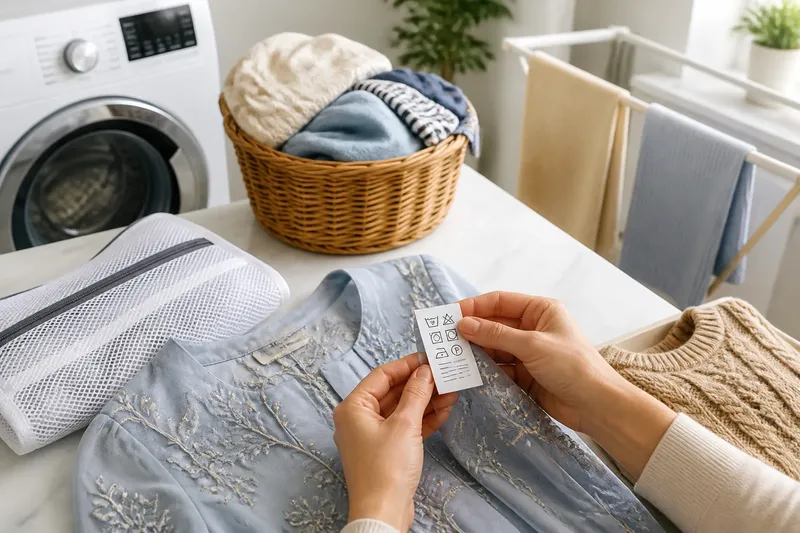
A common care-label mistake is to follow the wash symbol and overlook the rest. That can leave a machine-washable garment misshapen after drying or expose a delicate trim to a treatment it cannot tolerate.
Read the clothing care label as a set of instructions for the assembled garment. Check every care method, then compare the directions with the garment’s layers and details before choosing how to clean it.
Read every symbol
Care symbols cover separate tasks: washing, bleaching, drying, ironing, and professional cleaning. A crossed-out symbol rules out that method; a temperature or process mark narrows how you may use it. An underline beneath a symbol can call for gentler handling.
Read written directions alongside the symbols. Words such as “do not,” “only,” or “with like colors” can change your decision, so do not pick whichever instruction seems easiest.
The fiber-content tag and care label answer different questions. A tag naming cotton, wool, polyester, or a blend identifies fibers, but it may not describe a lining, fused layer, surface finish, or sewn-on trim.
Match care to construction
Inspect the whole garment before washing. Look for lining, shoulder pads, pleats, elastic, embroidery, glued embellishments, contrasting panels, and closures that could snag fabric. The care label applies to the finished item, not just its largest piece of fabric.
Choose among the methods the label permits. Follow specific directions for items that need professional cleaning or flat drying; use a gentler permitted cycle for washable clothes with delicate details; and ask a professional cleaner when the instructions are unclear or the construction is complex.
Say you have a washable blouse with a sheer overlay and sewn-on beads. You check the label and find that it permits a delicate machine cycle, then fasten the closures, put the blouse in a mesh bag, and select that cycle. The expected observable result is that the blouse has less contact with other laundry; if the label instead forbids machine washing, you do not use this method.
Choose drying deliberately
A garment may be machine washable but unsuitable for a tumble dryer. Read the drying instruction separately and use the specified method: line drying, drip drying, or drying flat are not interchangeable.
Use the garment’s shape to guide setup within the label’s directions. A lightweight shirt may hang on a hanger, while a heavy knit can stretch under its own weight and may need a flat surface. If the label permits tumble drying, observe any heat or cycle limits and remove the item when dry.
Treat stains with care
Routine-care instructions do not necessarily explain how to remove a particular stain. Read the stain remover’s directions for the fabric and color, and test a hidden area only if the product instructions allow it. Blot delicate surfaces rather than scrubbing, and avoid heat unless the care and product directions permit it.
Do not assume bleach is suitable just because a garment is white. Check the label’s bleaching symbol and consider colored thread, printed panels, or finishes that may react differently from the base fabric.
What if instructions are unclear?
What if the label is missing?
Check for a second label in a side seam or inner pocket, then look for care information from the brand if available. If no directions turn up, consider visible materials and construction; when a lining, finish, or trim could be damaged, avoid a risky cleaning method and ask a professional cleaner.
Can I wash a dry-clean-only garment at home?
Do not treat “dry clean only” as permission to wash gently at home; water and agitation can affect shape, finish, or components. Ask a qualified cleaner whether another service is appropriate for the garment.
What if the label and fabric seem to disagree?
Follow the complete care label rather than relying on a general rule about a fiber. If the directions seem unclear or the construction is unusual, contact the manufacturer or a professional cleaner before trying another method.
Should I wash a new garment before wearing it?
A new garment does not automatically need washing. Check its care label and condition; if you decide to wash it, use a permitted method and consider washing it separately if color transfer is a concern.
Use a quick decision check
Before washing, check these details and let the result determine your next move:
- Check that the care label is present and legible; if it is, follow it, but if it is missing or unreadable, look for a second label or brand guidance before cleaning.
- Check every wash, bleach, dry, iron, and professional-care instruction; if they permit a home routine you can follow, use it, but if they conflict or remain unclear, pause and ask the manufacturer or a cleaner.
- Check for lining, padding, glued trim, beads, or delicate panels; if they are absent and the label permits machine washing, use the stated cycle, but if they are present, choose a gentler permitted method or consult a cleaner.
- Check the drying symbol; if it permits the dryer, observe its heat or cycle limits, but if it calls for line drying or flat drying, use that method instead.
- Check whether a stain remover is suitable for both fabric and color; if its directions allow use and a hidden-area test is permitted, follow them, but if not, avoid the product and seek another compatible option.
- Check pockets and fasteners; if pockets are empty and closures are secured, proceed with the permitted routine, but if not, empty the pockets and close or protect the fasteners first.
Keep a mesh laundry bag and drying rack available for items whose labels permit those methods. Sort by care needs as well as color: two dark garments may need different cycles.
When the clothing care label leaves room for doubt, pause, inspect the full garment, and choose only among methods the instructions allow. A quick check before washing is easier than trying to correct damage afterward.